Living through the work · Boca Raton, FL
How Long Are You Without a Kitchen in Boca Raton?
How long are you without a kitchen in Boca Raton is a different question from how long the project takes, and the second is the number most quotes give you. Yes, you can stay in the house. A countertop swap costs you 1–2 days, refacing 3–5 days, a full remodel 2–3 weeks, and a layout change 4–6 weeks. Whether that is bearable is decided by scheduling, not by how tough you are.
- Full remodel, in your house
- 2–3 weeks
- · inside a 3 to 6 week project
- Layout change, in your house
- 4–6 weeks
- · inside an 8 to 12 week project
- Licensed & insured: CGC1524886
- 350+ projects completed
- 2-year labor warranty
- Answered 7 AM–10 PM, 7 days
The Number on the Quote Is Not the Number You Live Through
A quote gives you a total: weeks from signature to finished kitchen. That total includes design, cabinet fabrication, countertop fabrication and, when it applies, municipal review, and almost none of that happens in your house. The number you actually live through is the days a crew is inside.
The two run on different scales, and the gap is the whole point. A quartz countertop replacement is a 2–3 week project with 1–2 days of work in the house. Refacing is 2–4 weeks with 3–5 days inside. A small kitchen is a 3–5 week project with about 2 weeks of it in your way. A full remodel is 3–6 weeks with 2–3 weeks inside. A layout change is 8–12 weeks with 4–6 weeks inside.
Read those pairs and you can see where the misery actually is. Two projects can carry the same headline figure and be completely different to live in: one is mostly a shop building your cabinets while you cook normally, the other is mostly your kitchen being a construction site.
Ask for both numbers before you sign anything. If a quote only offers the total, the days inside are not being planned, and the days inside are the part you experience.
The Rule That Decides Whether It Is Days or Months
Nothing comes out of your kitchen until what replaces it is built and physically here. That single rule separates a project you can live in from a story people tell for years.
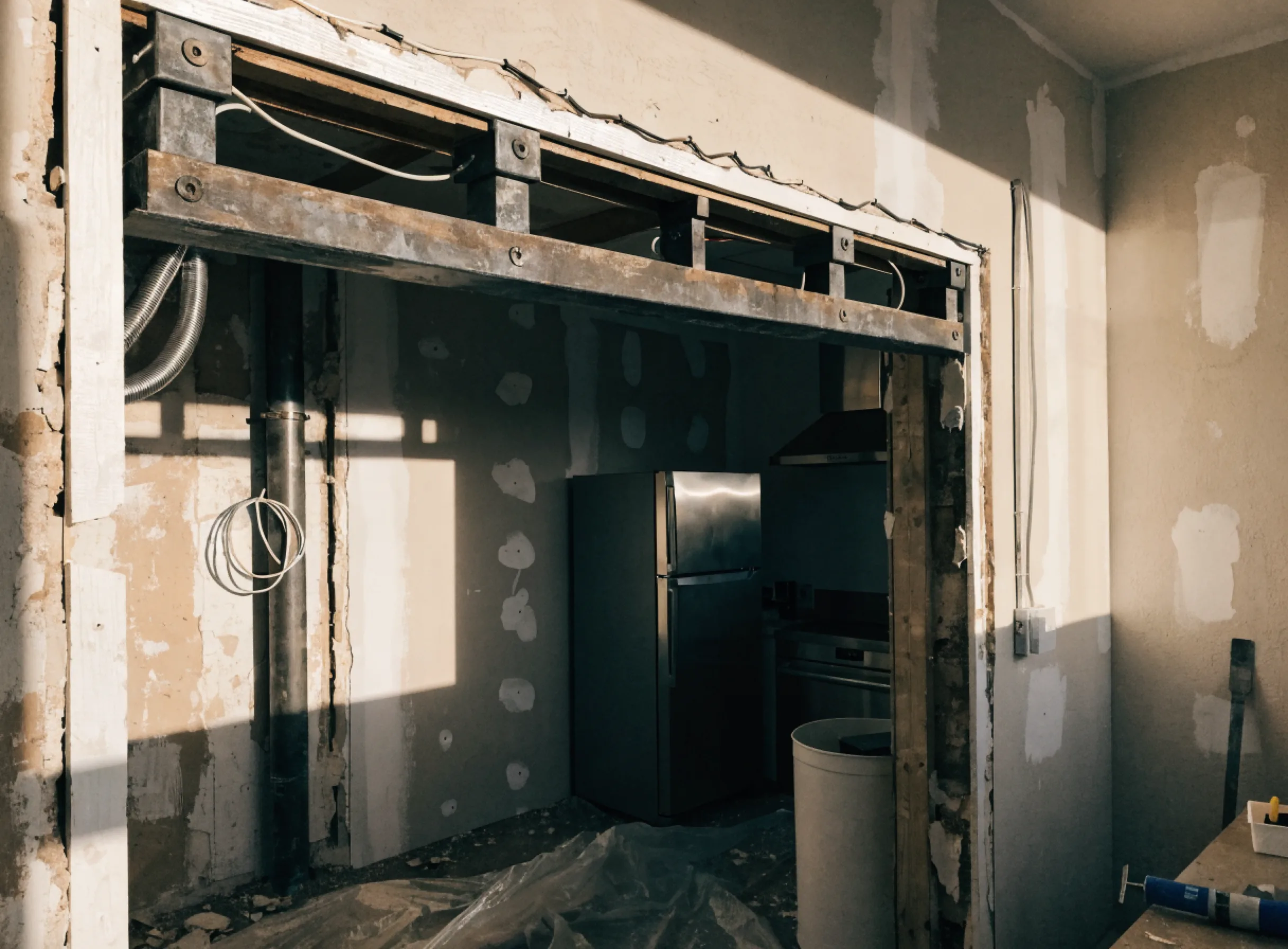
It gets broken for a reason that sounds sensible: demolition is the visible start, so tearing out early feels like progress. It is not. Cabinets and countertops are fabricated to measurements, and the countertop is templated off the cabinets after they are installed and level, so the sequence has a fixed order no amount of urgency changes. Demolish first and you are simply living in the rubble for the fabrication weeks instead of cooking through them.
While the crew is inside, the other thing worth settling in advance is dust. Most cutting belongs in a shop, but cutouts and adjustments happen on site, and stone contains crystalline silica. The federal construction standard requires, for handheld saws of any blade diameter, a saw with an integrated water delivery system that continuously feeds water to the blade. Ask what gets cut in the house, where, and what separates that room from the rest of it.
What You Lose First, and What You Can Keep
It is the water, not the stove. People plan around losing the range and are caught out by losing the sink, because the sink is what makes everything else possible. Set up somewhere else before day one: the refrigerator moved to a garage or a hallway where it can stay plugged in, a microwave and a kettle on a table, and the bathroom or laundry sink for washing up. Plan the rubbish too, because a kitchen without a bin fills a house quickly.
The other thing to establish early is what the crew is allowed to disturb. If the house was built before 1978 the work is regulated: the federal renovation rule requires that anyone paid to perform work that disturbs painted surfaces in homes built before 1978 be certified and use lead safe practices. That changes what containment looks like in a house somebody is sleeping in, and it is a question to ask before the first day rather than on it.